


In the modern world, the demand for high - quality glass products is ever - increasing, especially in applications where clear visibility and a clean appearance are crucial. AR (Anti - Reflective) coated glass has emerged as a popular choice in various industries, from consumer electronics to architectural design. One of the significant advantages of AR coated glass is its ability to resist smudges. As an AR coated glass supplier, I'd like to delve into the scientific principles behind this remarkable property.
Understanding AR Coating
AR coating is a thin film applied to the surface of the glass. The primary purpose of this coating is to reduce the amount of light reflected off the glass surface, thereby increasing the amount of light transmitted through it. This is achieved through the principle of thin - film interference. When light hits the AR - coated glass, the coating creates a phase difference between the light reflected from the top of the coating and the light reflected from the glass - coating interface. If the thickness of the coating is carefully chosen, these two reflected light waves can interfere destructively, resulting in a significant reduction in the overall reflected light.
However, the benefits of AR coating go beyond just reducing reflection. It also plays a crucial role in smudge resistance. The key lies in the surface properties of the coating.
Surface Energy and Smudge Resistance
The concept of surface energy is fundamental to understanding how AR coated glass resists smudges. Surface energy is a measure of the excess energy at the surface of a material compared to its bulk. Materials with high surface energy tend to attract other substances, while those with low surface energy repel them.
AR coatings are designed to have a low surface energy. When a liquid, such as oil from our fingers, comes into contact with the glass surface, the low - surface - energy coating makes it difficult for the liquid to spread and adhere. Instead of forming a thin film over the surface, the liquid beads up and can be easily wiped away. This is similar to the behavior of water on a lotus leaf, which has a super - hydrophobic surface with extremely low surface energy.
Hydrophobic and Oleophobic Properties
Many AR coatings also incorporate hydrophobic and oleophobic properties. Hydrophobicity refers to the repulsion of water, while oleophobicity refers to the repulsion of oils.
Hydrophobic coatings prevent water from wetting the glass surface. When water droplets land on the AR - coated glass, they form spherical droplets that roll off easily. This is because the hydrophobic coating reduces the contact area between the water and the glass, minimizing the adhesion force.
Oleophobic coatings work in a similar way for oils. Oils, which are common components of fingerprints and smudges, are repelled by the oleophobic surface. The molecular structure of the oleophobic coating is designed to interact minimally with oils, causing the oil droplets to bead up and making them easier to remove.
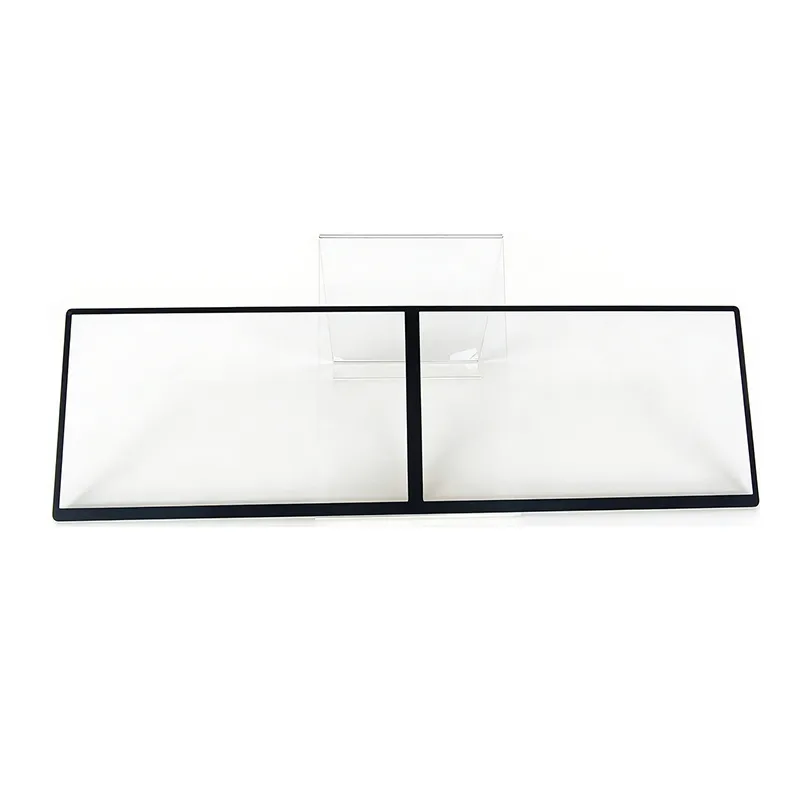

Nanostructure of the Coating
The nanostructure of the AR coating also contributes to its smudge - resistant properties. Nanostructured coatings have a rough surface at the nanoscale. This roughness creates air pockets between the coating and the liquid (either water or oil) that comes into contact with it.
These air pockets act as a barrier, reducing the contact area between the liquid and the coating surface. As a result, the adhesion force between the liquid and the glass is significantly reduced. The liquid droplets are more likely to roll off or can be easily wiped away without leaving a residue.
Applications and Product Offerings
The smudge - resistant property of AR coated glass makes it ideal for a wide range of applications. In the consumer electronics industry, it is used in smartphone screens, tablets, and laptop displays. The ability to resist smudges ensures that the screen remains clear and easy to view, even with frequent use.
In the architectural field, AR coated glass can be used in windows and facades. It not only reduces glare but also keeps the glass clean, reducing the need for frequent cleaning.
As an AR coated glass supplier, we offer a variety of products to meet different customer needs. Our Anti Glare Glass Sheet is designed to reduce glare and resist smudges, making it perfect for display applications. The Super Hydrophobic Glass provides excellent water - and oil - repellent properties, ensuring a clean and clear surface at all times. And our High - transmittance AR Coated Glass combines high light transmittance with smudge resistance, making it suitable for a wide range of optical applications.
Contact for Procurement
If you are interested in our AR coated glass products, we welcome you to contact us for procurement and further discussions. Our team of experts is ready to assist you in finding the best solution for your specific needs. Whether you are an electronics manufacturer, an architect, or in any other industry that requires high - quality glass products, we can provide you with the right AR coated glass to meet your requirements.
References
- Born, M., & Wolf, E. (1999). Principles of Optics: Electromagnetic Theory of Propagation, Interference and Diffraction of Light. Cambridge University Press.
- Bhushan, B. (2012). Springer Handbook of Nanotechnology. Springer.
- He, J., & Yu, X. (2018). Anti - reflective and self - cleaning coatings: A review. Journal of Materials Chemistry A, 6(23), 10749 - 10774.


